Generated AI Images: The Work Behind the Image
There’s a common belief that AI-generated images appear instantly and perfectly. Type a sentence, press a button, and a finished illustration appears.
Anyone who actually works with AI art knows that’s rarely how it happens.
More often, it’s a process of experimentation, correction, and patience. In many ways it isn’t that different from traditional illustration. The tools are different, but the creative work still happens in the decisions.
The Iteration Problem
The first image almost never works.
Sometimes the lighting is wrong. Sometimes the anatomy is strange. Sometimes the composition is close but not quite right. Faces can look slightly off. Limbs can be twisted. Objects can merge into each other in ways that make no sense.
So you try again.
And again.
And again.
Most of the illustrations used in my articles and projects are the result of five to ten generations before one version comes close to what I had in mind. Even after that point, the work usually isn’t finished.
Once a usable version appears, it becomes the starting point for the real refinement.
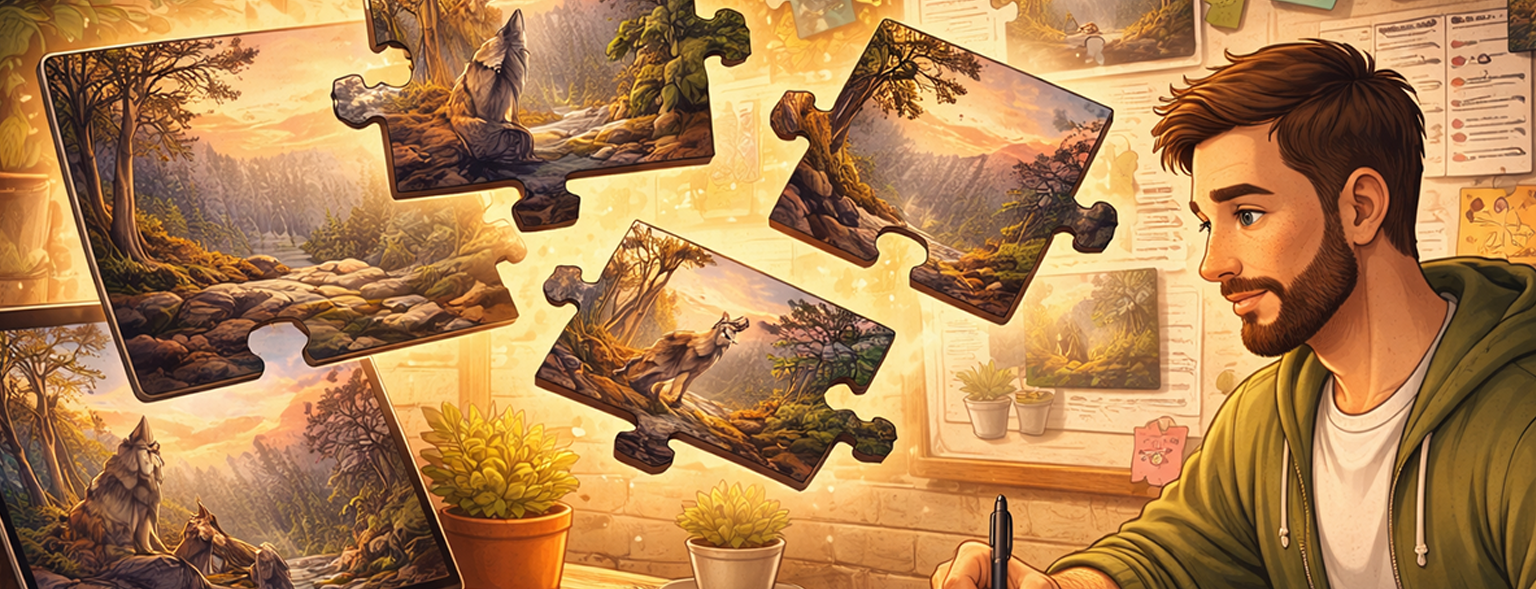
Puzzle Piece Artwork
Sometimes the best image doesn’t come from a single generation at all.
One version might have the perfect background. Another might have the right pose. A third might capture the expression that finally feels right.
At that point the process becomes a bit like assembling a puzzle.
Parts of different images get combined and rearranged until the composition begins to match the original idea. In most cases I use Photoshop for this stage—cutting sections from one image and blending them into another.
After that, I will often run the image through one final AI generation so the model can smooth the seams and unify the details. That helps remove the visual breaks that sometimes appear when multiple images are stitched together.
The finished illustration may look simple, but the process behind it can easily take hours of work.
Why AI Works for Me
Years ago I could draw well enough to sketch ideas for my work.
That changed after my stroke.
Like many people who experience neurological damage, some abilities simply don’t return the way they once were. Drawing is one of the skills that became difficult for me.
AI image generation opened a door that would otherwise have stayed closed.
Instead of trying to force a skill my brain no longer handles well, I can focus on directing images, shaping them, and refining them through iteration. The creative control is still there, but the physical barrier is gone.
For someone in my position, that’s an incredible tool.
The Copyright Advantage
Another benefit of AI-generated images is their flexibility.
Most AI images do not carry traditional copyright protection. Because of that, they can usually be used freely in blog posts, promotional material, and independent creative projects.
For authors and small creators, this opens a lot of possibilities. Visual worlds can be built around stories without the expense of commissioning large numbers of illustrations.
It allows experimentation, and experimentation is where a lot of creativity happens.
Inspiration Has Always Been Part of Art
One criticism that comes up frequently is the idea that AI art somehow “steals” from other artists.
But every artist in history has learned by studying the work of others.
Painters study masters from earlier centuries. Illustrators study anatomy and composition from artists they admire. Writers absorb techniques from the books they read.
Creative work has always been built on influence.
AI systems learn patterns from large collections of existing work in much the same way. The result is not a copy of a specific piece of art, but a new image shaped by patterns learned across thousands of examples.
In that sense, the process isn’t very different from how human artists develop their own skills.
A Tool, Not a Replacement
Like any creative tool, AI art doesn’t replace imagination.
It responds to direction.
The prompts, the revisions, the corrections, and the decisions still come from the person guiding the process. The final image is usually the result of many attempts, adjustments, and careful choices.
Behind every successful AI image is a long chain of small decisions.
And sometimes, quite a few hours of work.