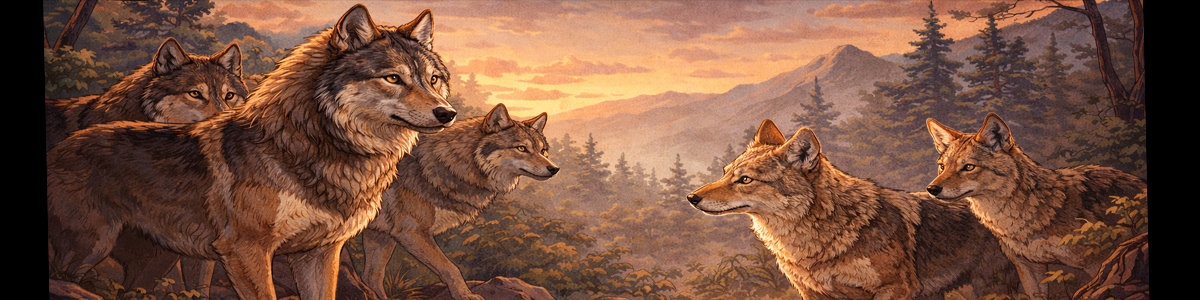
How Coy-Wolves Survive Alongside Coyotes
When people think about predators, they usually picture the biggest animals first. Wolves, mountain lions, bears—large predators that dominate a landscape through strength and size.
Coyotes are different.
They aren’t the strongest predators in North America, but they may be the most adaptable. Over the last hundred years coyotes have spread across nearly the entire continent, surviving in deserts, forests, farmland, suburbs, and even major cities.
That adaptability is one of the foundations of Ember- The Coy-Wolf Chronicles.
In the valley where the story takes place, ecosystems have been unstable for generations. Large prey disappears for long stretches of time. When that happens, predators that depend on big game either move on or die out.
Coyotes remain.
Masters of Adaptation
Many predators rely on very specific prey. Wolves prefer large animals like deer or elk. Mountain lions depend heavily on deer as well. When those animals disappear, the predators that rely on them usually follow.
Coyotes operate differently.
They will hunt rabbits, rodents, birds, insects, fruit, carrion—almost anything edible. When food becomes scarce, they shift their diet. When conditions change again, they shift back.
This flexibility makes them incredibly difficult to eliminate.
Historically, even when widespread eradication campaigns targeted coyotes across the American West, they adapted. When populations were reduced, the remaining animals produced larger litters. Packs spread out and new territories appeared.
They don’t collapse easily.
They adjust.
Survival Through Dispersal
Coyotes also spread across the landscape in ways many predators do not.
Large predators often hold rigid territories. Coyotes are far more fluid. Young animals frequently travel long distances when they leave their birth territory. Over time this creates a loose network of groups and wandering individuals.
If one group disappears, another eventually moves in.
This constant movement allows coyotes to repopulate areas quickly and survive even when pressure from other predators increases.
Where Coy-Wolves Fit In
Coy-wolves occupy an unusual place between wolves and coyotes.
They are larger than coyotes and capable of bringing down bigger prey when hunting together. At the same time, they retain much of the coyote’s flexibility. They can survive on smaller animals when necessary, shifting their diet during lean times just as coyotes do.
In other words, coy-wolves can survive the valley’s harsh conditions as well.
But they live differently.
Coyotes spread widely across the landscape, forming loose family groups and shifting territory as needed.
Coy-wolves behave more like wolves. They form tighter social units and hold territory more aggressively. This makes them powerful hunters, but it also makes them more vulnerable to sudden changes. If a pack is wiped out, another group does not immediately appear to replace it.
Their strength comes from unity.
But that unity also makes them rare.
Strength vs. Resilience
In the valley, coy-wolves represent a balance between two survival strategies.
They inherit the wolf’s cooperative hunting ability and physical strength, but they also inherit the coyote’s adaptability and ability to live off smaller prey.
This makes them formidable animals, capable of surviving where wolves alone might struggle.
But coyotes still possess one advantage.
They scatter.
Coyotes survive by spreading out across the land, living in places larger predators overlook. When pressure rises, they disperse and regroup later.
Coy-wolves are stronger, but coyotes are harder to erase.
Why Coyotes and Humans Look So Similar
The more closely coyotes are studied, the more their survival strategy begins to resemble something familiar.
Coyotes don’t dominate ecosystems through strength. They survive through adaptation.
Humans operate in much the same way.
Both species are opportunists. Coyotes eat whatever is available—small animals, fruit, insects, carrion, even human garbage when necessary. Humans adapt their food sources and technologies depending on where they live.
Both species spread rapidly across landscapes. Coyotes disperse widely, exploring new territories and establishing new groups. Humans migrate, settle new areas, and reshape their environments.
Both survive in the margins. Coyotes live comfortably in deserts, forests, farmland, and cities. Humans survive in tundra, mountains, deserts, and jungles not because our bodies are perfectly suited to those places, but because our behavior adapts.
The difference lies in the tool each species uses.
Coyotes rely on instinct, cunning, and behavioral flexibility.
Humans rely on intelligence, planning, and technology.
But the strategy is the same:
adapt faster than the environment changes.
Why Coyotes Could Become Even Smarter
Interestingly, the conditions that favor coyote survival also create evolutionary pressure toward greater intelligence.
In nature, intelligence tends to evolve under three conditions:
- unstable environments
- complex social behavior
- competition with other intelligent species
Coyotes already experience the first two.
They live in constantly changing environments and operate within flexible social structures where individuals must read the behavior of others.
Add long-term interaction with humans, and the pressure for behavioral intelligence increases even more.
Coyotes already show many early signs of cognitive flexibility. They change hunting strategies depending on prey, adjust activity patterns to avoid danger, and use human structures such as roads, railways, and irrigation systems.
Urban coyotes are particularly striking. They navigate traffic, learn garbage schedules, and avoid human patrol routes.
These are all forms of problem-solving behavior.
Intelligence Without Losing the Animal
Evolution toward intelligence does not mean animals suddenly become human.
More likely changes would include:
- stronger memory
- more complex communication
- better cooperation during hunts
- strategic decision-making
- longer learning periods for young animals
Animals would remain animals, but with deeper awareness and coordination.
The valley described in the story—where ecosystems shift, predators compete, and humans reshape the environment—creates exactly the kind of pressures that favor these traits.
The Survivors of the Valley
In the end, the valley becomes a place where different survival strategies collide.
Wolves represent dominance and territorial control.
Coy-wolves represent the balance between strength and adaptability.
Coyotes represent persistence and flexibility.
Humans represent intelligence and environmental control.
When the environment shifts, each species responds differently.
The strongest predator is not always the one that survives the longest.
More often, survival belongs to the animal most willing to adapt.
And few animals on the continent adapt better than the coyote.